Boomerang Casino Payment Methods
Ten methods, all settled in euro, all with the same closed-loop rule on the way out. This page lists what the cashier actually accepts from an Irish account, what it costs you, and how long each one really takes once the pending window is over.
The Short Answer
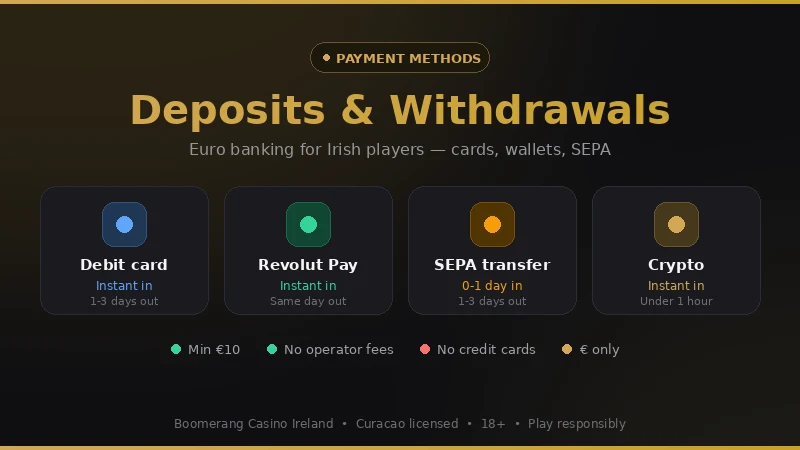
Boomerang Casino takes Visa and Mastercard debit, Revolut Pay, Apple Pay, Google Pay, Skrill, Neteller, MiFinity, SEPA bank transfer and a handful of cryptocurrencies. Deposits start at €10 on cards and wallets, €20 by SEPA, €25 in crypto. Nothing is charged by the cashier at either end. Withdrawals go back to the method you deposited with, take up to 24 hours in pending review, and then anything from an hour (crypto) to three working days (SEPA). Credit cards are a bad idea in Ireland because your bank will price the transaction as a cash advance.
Every Boomerang Casino Payment Method
The list below is what an Irish account sees in the cashier. It is shorter than the one an operator with a full European licence would show you, and two of the entries — Skrill and Neteller — are worth avoiding for reasons covered further down. Limits are per transaction. The maximums are soft: verified accounts and long-standing players get raised on request, and nobody is going to tell you that up front.
| Method | Min | Max | Deposit speed | Fee | Withdrawal |
|---|---|---|---|---|---|
| Visa / Mastercard debit | €10 | €5,000 | Instant | None | 1–3 working days |
| Revolut Pay | €10 | €10,000 | Instant | None | 2–6 hours |
| Apple Pay | €10 | €2,000 | Instant | None | Deposit only |
| Google Pay | €10 | €2,000 | Instant | None | Deposit only |
| Skrill | €10 | €10,000 | Instant | None at cashier | Under 24 hours |
| Neteller | €10 | €10,000 | Instant | None at cashier | Under 24 hours |
| MiFinity | €10 | €5,000 | Instant | None | Under 24 hours |
| SEPA bank transfer | €20 | €20,000 | 0–1 working day | Bank may charge | 1–3 working days |
| Bitcoin / Litecoin | €25 | €50,000 | Instant | Network fee only | Under 1 hour |
| USDT (TRC-20) | €25 | €50,000 | Instant | Network fee only | Under 1 hour |
Limits verified 1 September 2026 on a euro account registered in Ireland. Individual accounts can differ after a risk review.
Bank Rails: SEPA and What Your Bank Does With It
A SEPA credit transfer is the slowest way in and one of the slower ways out, but it has the highest ceiling and it is the rail Boomerang falls back on when you have won more than you deposited. If you are ever going to take out €8,000, it will almost certainly land in your current account by SEPA rather than back on the card.
SEPA Instant is a separate scheme, and Irish banks have been uneven about it. AIB and Bank of Ireland both support instant euro payments now, PTSB does too, and Revolut has for years. That does not mean the casino sends by the instant scheme — most offshore acquirers still use the standard rail, which settles next working day. Send money on a Friday evening and it moves on Monday.
AIB
Gambling block available in the app under card controls. Once it is on, card deposits fail silently and there is a 48-hour cool-off before you can turn it off again.
Bank of Ireland
Same idea, called a gambling transaction block. Debit works normally when it is off; credit card gambling is priced as a cash advance either way.
Revolut
Gambling is blocked by default on new Irish accounts. Security → Gambling block. It is the single most common reason a first deposit fails here.
An Post Money and N26 both work on the card rail and behave like any other Visa debit. Credit union current accounts are the awkward one: the debit card usually goes through, but several credit unions apply a merchant-category block that nobody advertises, and support cannot lift it for you.
Wallets: Revolut Pay, Skrill, Neteller, MiFinity
Revolut Pay is the one that matters in Ireland. Roughly three in five adults here hold a Revolut account, and it is the only wallet on the list that gets a same-day payout as a matter of routine rather than as an exception. You approve the payment in the Revolut app rather than typing a card number, which also sidesteps the 3-D Secure step that trips up a lot of card deposits. The full walkthrough, including the two limits people run into, is on the Revolut Pay page.
Skrill and Neteller are both listed and both work, but read the bonus terms before you use either. On most offers here, a Skrill or Neteller deposit is excluded from the welcome match — the money lands, the bonus does not. That exclusion is standard across the industry and it catches people every week. If you intend to claim anything from the bonus page, fund with a card or Revolut.
MiFinity is the quiet option: fewer users, no bonus exclusion, and it settles about as fast as Skrill. It is worth setting up only if the other rails are giving you trouble.
Apple Pay and Google Pay are deposit-only. That is not a Boomerang quirk, it is how the tokenised card schemes work — there is no push-to-card path back to a wallet token. Deposit with Apple Pay and your winnings come back to the underlying card or, over the deposit amount, by SEPA.
Debit Cards, and Why Not Credit
A Visa or Mastercard debit card is still the default for most people, and it works. Deposits are instant. Withdrawals use Visa Direct or Mastercard Send where the issuer supports it, which is why the range says one to three working days rather than a firm number — Irish issuers vary, and a card that pushes funds back in six hours one week can take three days the next.
Credit cards: the cash advance trap
Ireland has no outright ban on credit card gambling of the sort the UK introduced in 2020. What it has instead is bank pricing. Irish issuers code gambling top-ups under merchant category 7995 and treat them as a cash advance: no interest-free period, interest accruing from the transaction date, and a cash advance fee on top. A €200 deposit on a credit card can cost you €6 to €10 before you have placed a single spin. Use a debit card.
One more card detail that causes grief: the name on the card must match the name on the account. Joint accounts, a partner's card, a company card — all of them will pass at deposit and then stop the withdrawal dead at verification, because the payout has to go back to a card you personally own. If the card is not in your name, do not use it.
Why a Payment Gets Declined
Ranked by how often it is actually the cause, based on what Irish players report rather than what the help pages say. Work down the list in order; you will nearly always stop at one of the first three.
1. The gambling block on your bank or Revolut account
On by default for new Revolut accounts in Ireland, and toggled on more often than people remember on AIB and BOI. The decline is silent — you get a generic cashier error, not a message about the block. Turn it off, wait the cool-off period, retry.
2. 3-D Secure timed out
The approval push lands in your banking app and expires in a couple of minutes. If you switched apps, took a call, or the phone locked, the deposit fails. Retry with the banking app already open.
3. Card name does not match the account name
Some acquirers check this at deposit, most check it at withdrawal. Either way it ends in a refusal. The card must be yours.
4. Issuer risk decline on an offshore merchant
The acquirer sits outside the EEA, so a first-time transaction to it looks unusual. A second attempt after a few minutes often goes through; a third rapid attempt usually locks the card for the day.
5. Unverified account over the pre-KYC ceiling
You can deposit before verification, but not without limit. Once cumulative deposits pass roughly €2,000 the cashier stops accepting anything until documents are approved.
6. Wrong currency on the source account
A sterling or dollar balance funding a euro deposit triggers a conversion, and some issuers refuse the combination outright. Fund from the euro pocket.
How It Looks on Your Statement
You will rarely see the word Boomerang. Offshore casinos route card traffic through payment service providers, and it is the provider's descriptor that reaches your bank — an eight-to-twelve character string plus a city, often somewhere in Cyprus, Malta or Estonia. People see that, assume the card has been skimmed, and file a chargeback against their own deposit. Do not do that: a chargeback on a gambling deposit closes the account and forfeits the balance.
If you genuinely do not recognise a line, check the transaction time against your deposit history in the cashier before you ring the bank. The amount and timestamp will match to the minute.
A practical note for anyone applying for a mortgage: Irish lenders read six months of statements, and gambling descriptors are exactly the sort of thing an underwriter flags. That is a real consequence of funding by card or SEPA rather than a moral point.
Mistakes That Cost People Money
Depositing €10 and expecting the welcome match
The cashier minimum is €10. The offer minimum is €20. Deposit ten and you get no bonus and no way to add it retroactively.
Funding with Skrill or Neteller then claiming a bonus
Excluded on most offers. Check the terms of the specific promotion, not the general banking page.
Leaving verification until the first withdrawal
Documents take up to 48 hours to review and the withdrawal clock does not start until they clear. Upload them on day one and the payout is days faster.
Cancelling a pending withdrawal to keep playing
The reverse button is deliberately easy to press. Every reversal restarts the pending window from zero, and most balances that get reversed never get withdrawn at all.
Depositing by card and asking for a crypto payout
Closed loop. Up to the amount you put in, the money returns the way it came. Mixed rails only apply above that.
Using someone else's card "just this once"
It will deposit fine and then fail verification. Third-party funding is the fastest route to a frozen balance anywhere in this industry.
Before and After: What Changed for Irish Players
| Item | Was | Now |
|---|---|---|
| Irish licensing | No regulator, Revenue-issued betting permits only | GRAI licensing remote betting since 1 July 2026; remote gaming still to come in the 2027–28 phase |
| Credit cards | Accepted, priced as a normal purchase | Coded as a cash advance by Irish issuers; the Gambling Regulation Act 2024 bans credit acceptance by licensees |
| Revolut | Card top-ups only | Revolut Pay as a first-class method, with the gambling block on by default |
| Withdrawal routing | Pick any verified method | Closed loop back to the deposit rail, overflow by SEPA |
| Curaçao licensing | Master-and-sublicence system, little oversight | Direct licensing under the Curaçao Gaming Authority since the LOK reform, with a published complaints route |
Boomerang Casino Payments FAQ
What is the minimum deposit at Boomerang Casino in Ireland?
Ten euro on cards, Revolut Pay and most wallets. SEPA bank transfer starts at €20 and crypto at €25. The €20 figure you see quoted on the homepage is the minimum that qualifies for the welcome offer, which is a different number from the minimum the cashier will accept.
Can I use a credit card at Boomerang Casino?
The cashier will sometimes accept one, but Irish banks increasingly treat gambling top-ups as a cash advance, which means interest from day one and a separate fee. AIB, Bank of Ireland and PTSB all offer a gambling block on card accounts. Use a debit card or Revolut instead.
Does Boomerang Casino charge fees on deposits or withdrawals?
No fee is applied by the cashier on any method listed here. Your own bank can still charge you, most commonly on a non-instant SEPA transfer or on a currency conversion if your account is not held in euro.
Why was my deposit declined even though I have money in the account?
In Ireland the usual cause is the bank, not the casino. Merchant category code 7995 is blocked by default on many Revolut and AIB cards, and the block is silent — the payment simply fails. Check your gambling block setting first, then 3-D Secure, then whether the card name matches the account name.
Can I deposit with one method and withdraw to another?
Not usually. Boomerang applies closed-loop withdrawals, so money goes back down the same rail it came in on, up to the amount you deposited. Anything above that can be paid to a second verified method, normally SEPA.
Is Boomerang Casino licensed in Ireland?
No. Boomerang holds a Curacao licence and is operated by Rabidi N.V. The Gambling Regulatory Authority of Ireland began issuing remote betting licences on 1 July 2026, but remote gaming licences — the category an online casino needs — are not scheduled until the 2027 to 2028 phase. No online casino holds an Irish licence yet.
Are Boomerang Casino winnings taxed in Ireland?
Not for the player. Ireland taxes the operator through betting duty, not the punter. You do not declare casino winnings as income to Revenue.
How does the deposit appear on my bank statement?
Usually as a payment processor name rather than the word Boomerang — strings such as DAMAKA, ECOMMPAY or a similar acquirer reference. That is normal and is not a sign of fraud, but keep the transaction reference if you ever need to dispute one.
Fund in Euro, Verify Early, Withdraw the Same Way
Those three habits remove almost every payment problem people run into here. 18+ only. Gambling can be addictive — set a deposit limit before you set a budget.